The $40,000 Revolving Door
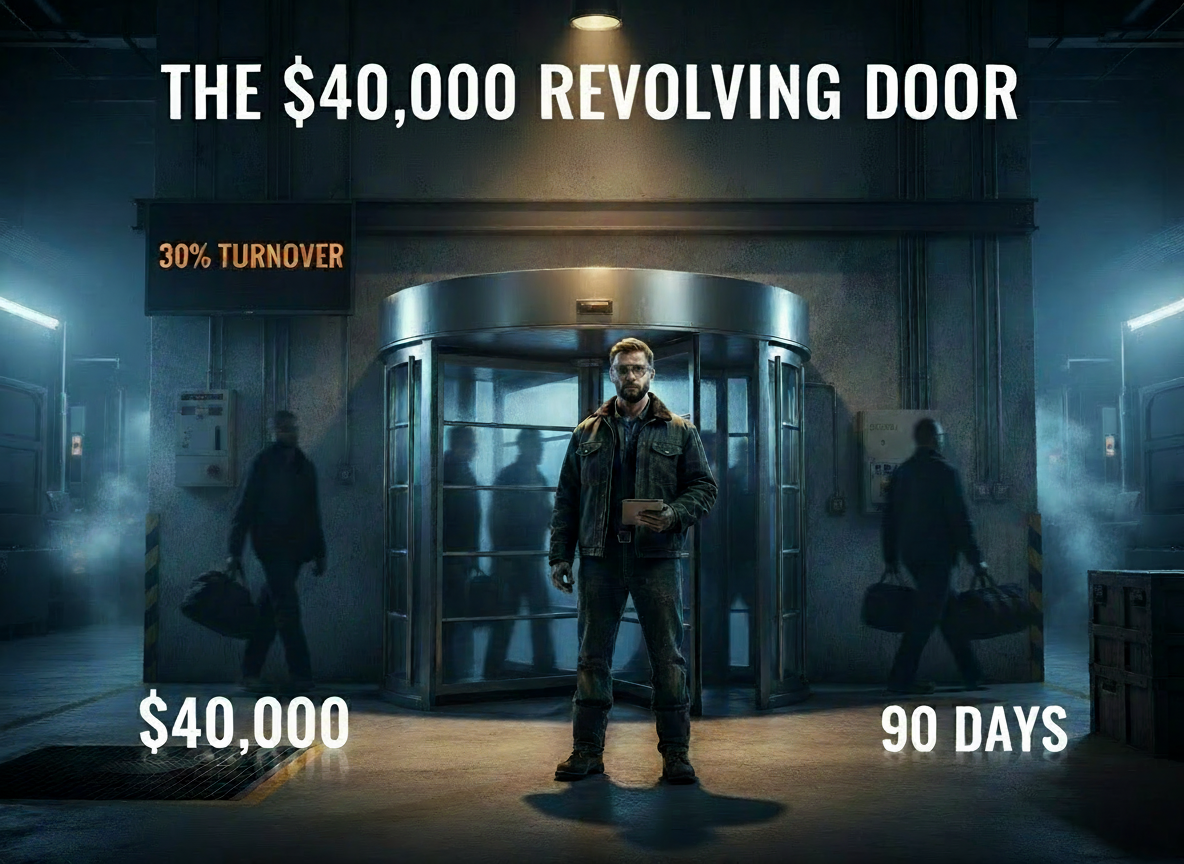
You want to know what's actually killing manufacturing right now?
It's not the economy. It's not automation. It's not a lack of applicants.
It's you.
More specifically — it's your hiring process. The same broken, copy-pasted, fear-driven checklist you've been using since 2005.
And the numbers prove it.
Let's Talk About the Elephant on the Shop Floor
Manufacturing turnover is averaging 26–28% annually in 2026.
For production workers? We're talking 30–38%.
And here's the number that should keep every plant manager up at night: replacing one production worker costs between $20,000 and $40,000.
Run that math on a 30-person shop.
That's potentially $270,000 walking out your door every single year.
Not because workers aren't loyal. Not because they don't care.
Because you're hiring the wrong way. Screening for the wrong things. And then wondering why the seat is empty again by month three.
The First 90 Days Tell the Whole Story
Here's a stat the industry doesn't want to admit:
33% of new-hire turnover happens in the first month.
ONE MONTH.
That means the people you fought to hire, interviewed, onboarded, and trained — a third of the ones who leave, are gone before you even get close to seeing a return on that investment.
That's not a skills gap. That's a systems gap.
You hired someone with the right credentials. But you didn't hire someone who was set up to win.
There's a difference. A massive one.
What You're Actually Screening For (And Why It's Backwards)
Most manufacturers still filter candidates like it's 1999.
Felony on the record? Hard pass.
No degree? Next.
90-day employment gap? Suspicious.
Meanwhile, manufacturing job openings just hit 495,000 in January 2026 — up 11% year over year.
You've got half a million open seats. And you're still playing gatekeeper with a checklist that eliminates the people who could fill them.
You're not protecting your company. You're just protecting your comfort zone.
I Said It on LinkedIn. The Internet Had Feelings About It.
A few weeks ago I posted this:
"You don't have a talent shortage. You have a cowardice problem. 433,000 open manufacturing jobs. And you're sitting here running the same broken hiring process you've been running for 20 years — checkboxes, degree requirements, automated rejections — wondering why nobody shows up. They showed up. You turned them away before a human being ever looked at their name."
It hit different.
Some people loved it. A lot of people shared it. And a handful of manufacturing managers lost their minds in the comments.
Good.
That post wasn't meant to be comfortable. It was meant to be true.
Because that's exactly what's happening. Every. Single. Day.
The man with the record who's been clean for 7 years — gone. Filtered out by an algorithm before his application hit a human desk.
The woman who aged out of a dying industry and just needs a shot — rejected for "insufficient experience."
The kid from the wrong zip code who will outwork everyone on your floor — never called back.
Those aren't hypotheticals.
Those are real people. And right now, your competitor is either hiring them — or losing to the one who does.
The Real Question Nobody's Asking
Why does a person with a gap in their resume make you nervous?
Maybe they were caring for a sick parent. Maybe they were dealing with addiction and got clean. Maybe they made a mistake — did the time — and came out the other side with more discipline and hunger than anyone on your current floor.
I've seen it. Over and over.
The guy who "failed" your background check.
The woman who was "overqualified" because she had a gap.
The kid who didn't have any experience but refused to quit.
Those are your people. You just don't know it yet — because you never gave them a shot.
The Courage Gap Looks Like This
It doesn't take courage to reject someone with a record.
It doesn't take courage to pass on the person who didn't go to college.
It takes courage to look at a résumé that doesn't fit the template — and see potential anyway.
It takes courage to build onboarding that actually sets people up to succeed, instead of throwing them to the floor and seeing who survives.
It takes courage to admit that your 30% turnover rate isn't a pipeline problem.
It's a leadership problem.
What the Comments Taught Me
When that LinkedIn post blew up, one comment stood out.
A manufacturer — let's call him Ron — pushed back hard. Said he takes in anybody who fills out an application. Gives them 3 months of hands-on training. Pays above-average wages.
And still — two-thirds can't figure it out. Half quit before 90 days. The ones who stay "still suck."
His conclusion: skills gap. My area just doesn't have the talent.
Ron — I hear you. I really do.
But here's what I asked him:
If 2/3 of your hires can't figure it out after 3 months of hands-on training — what does that tell you about the training?
If half quit before 90 days — what does that tell you about the culture they're walking into?
If the ones who stay still underperform — that's not a them problem. That's a system problem.
Ron's not a bad person. He's a frustrated one. And he's doing exactly what the industry trained him to do: blame the worker.
The bravest thing I see in manufacturing isn't a new machine or a new market.
It's a leader who looks at 30% turnover and says: "What am I doing wrong?"
The Blueprint
Here's what actually moves the needle. Not theory — practice.
1. Screen for coachability, not credentials. Ask candidates: "Tell me about a time you failed and what you did next." The answer tells you everything credentials never will.
2. Fix your first 30 days. If you don't have a structured onboarding plan — a real one, not a stack of forms and a floor tour — you are setting people up to fail. And then blaming them for it.
3. Expand your talent pool. Justice-impacted individuals. SNAP recipients. Veterans. Single parents returning to work. These communities are full of people who want a career, not just a paycheck. You just have to meet them where they are.
4. Measure what matters. Stop measuring "years of experience." Start measuring 90-day retention. 6-month retention. Productivity growth curves. That's what tells you whether your hiring is actually working.
This Is a $270,000 Decision
Every year you keep the same broken hiring process, you're choosing to pay for it.
The data is screaming at you.
Manufacturing turnover is costing the average small shop between $160,000 and $270,000 per year. That's not a rounding error. That's a second building. That's equipment. That's three more hires done right.
The talent is out there. It always has been.
The only thing missing is the courage to go find it.
Ready to close the Courage Gap in your shop?
Join the Hidden Talent Unlocked Workshop — a 90-minute live intensive where we don't just talk strategy, we build your complete sourcing system in real time. Custom-built for your industry. You leave with contacts, messaging, and a 30-day action plan.
👉 Register now — seats are capped at 25
Not ready for the live workshop yet? Grab the Quick-Start Toolkit — templates, frameworks, and outreach scripts you can implement on your own schedule.
👉 Get the Manufacturing Renaissance Quick-Start Toolkit
Drew "The MFG" Crowe is the founder of the New American Manufacturing Renaissance. He's a keynote speaker, workforce development advocate, and the bridge between the streets and the suites.
Got something to say about this? I want to hear it. Hit me at mgmt@the-mfg.com